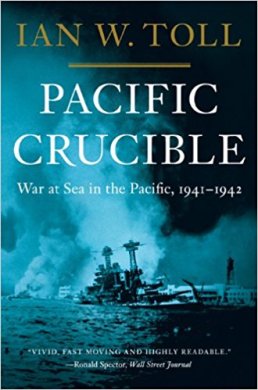
 It is a fortunate and powerful thing moment when a thinker trained for policy analysis finds his voice as a story-teller. That Ian Toll has lent that voice to narrating events in ‘the other war’ is a profound boon.
The persistent thread around which Toll weaves his story of the early war in the Pacific is the Alfred Thayer Bahan doctrine of concentration and battle wagons. The weaving is a subtle art in Toll’s hands, because the astonishingly brief moment between Pearl Harbor and Midway both debunked Bahan’s confidence in the battleship and proved that even Japan’s naval might was fallible when deployed without due concentration.
The author has delved deep into the minds of both Japanese and American warriors, from deck-swabbers and lowly engineers to admirals and their quirks. The result is a profoundly respectful telling, one that never allows the reader to forget that both strategy and humanity were as fully in play as it is possible to imagine. Continue Reading »
 is what we used to call a ‘sprawling’ work.
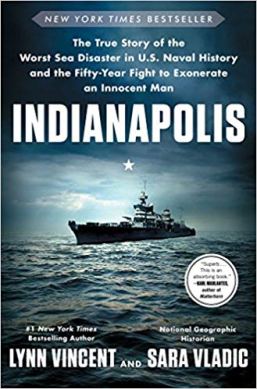 When a book like Lynn Vincent’s and Sara Vladic’s Indianapolis lies open on lap or desk, a reader sometimes forces himself from page to page. This one does, at any rate.
 deep into two volumes on World War II history, a pair of explanations of Colombia’s unending cycles of political violence (I live in Colombia), and the occasionally disturbing adventure by the late Robert Pirsig so memorably titled Zen and the Art of Motorcycle Maintenance.
 Because my wife and I work as cross-cultural missional servants in Colombia, I was immediately responsive when a dear reading friend recommended this novel, set as it is in our adoptive South American country. It felt a little bit like the reading version of a blind date.
 gentlest spirit, and a deep conviction that God’s care does not flee the human person who finds himself or herself afflicted with dementia. Nor does mercy abandon those who care for the dementia sufferer. I imagine this last group accounts for most readers of this very fine and wisely titled guidebook for one of life’s darker passages.
 The most astonishing thing about this very good Vietnam novel is that a man who has been a Marine Corps officer, a United States senator (Virginia), and Secretary of the Navy could write it. Seldom in my reading has someone who has both heard the snap of bullets and served in the political apparatus that decides and executes war written a version of events that is so searingly realistic about everything it touches.
 Arthur.


